
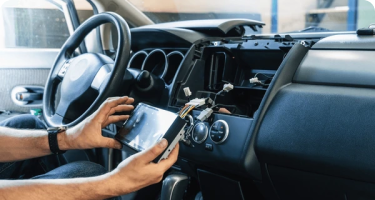
Stereo Installation
About Stereo Installation Listening to music in your vehicle can be a great experience, but it can also be frustrating. The quality of the sound in your car will mostly depend on the way you have your sound system set up. At TintingShops, we offer a wide variety of car stereo installation services. We can […]
Find Your Perfect Sound System
All 50 StatesTintingShops connects you with professional car audio installers across all 50 states — from a simple head unit swap to a full custom competition build, find a shop near you for every budget and every ear.
Sound Essentials
Parts + Labor
- Head unit upgrade (single-DIN/double-DIN)
- Full speaker replacement (all 4)
- Clean factory-matched wiring harness
- Bluetooth & hands-free calling
- Basic antenna adapter
Audio Upgrade
Parts + Labor
- Everything in Sound Essentials
- Component speaker set (door + tweeter)
- External amplifier (class A/B or D)
- Subwoofer + sealed/ported enclosure
- Sound deadening (doors & trunk)
- RCA signal run & ground kit
Competition Build
Parts + Labor
- Everything in Audio Upgrade
- DSP processor with tuning software
- Multiple amplifier setup
- Custom subwoofer enclosure (fabricated)
- Full vehicle sound deadening treatment
- Power upgrade (Big Three wiring)
- Professional time-alignment & EQ
Car Audio Component Guide
Not sure what you need? Click each component to learn what it does, what it costs, and the brands we trust.
Typical Cost
$80 – $800
Head Units (Receivers)
The head unit is the brain of your audio system — it controls every source, powers the display, and outputs signal to your amplifier or speakers. Modern units feature Apple CarPlay, Android Auto, DAB+ radio, and built-in DSP. A quality head unit is the single biggest upgrade most factory systems need.
Pro tip: Double-DIN units give you a touchscreen; single-DIN saves dash space. We'll check dash kit availability for your vehicle before recommending.
Trusted Brands
Typical Cost
$60 – $600 per set
Speakers
Factory speakers use cheap paper cones and low-power voice coils. Aftermarket speakers deliver wider frequency response, higher sensitivity, and far more power handling. Component sets separate the tweeter for true stereo imaging; coaxial sets keep it simple with a single driver per location.
Pro tip: Component sets (separate tweeter + woofer) always outperform coaxials for sound staging. We recommend them for every build above Sound Essentials.
Trusted Brands
Typical Cost
$100 – $1,200
Amplifiers
An amplifier takes the pre-amp signal from your head unit and delivers real, clean power to your speakers and subwoofer. Head units rarely exceed 20W RMS despite labeling — a dedicated amp can deliver 50–300W per channel at low distortion, dramatically improving clarity and dynamics at any volume.
Pro tip: Match your amp's RMS output to your speaker's RMS handling — headroom is good, too much is not. We calculate the right pairing for every build.
Trusted Brands
Typical Cost
$80 – $700 + enclosure
Subwoofers
Subwoofers reproduce the low frequencies (20–200Hz) that door speakers simply cannot move enough air to produce. A single quality 10" or 12" sub in a well-tuned enclosure transforms the listening experience, adding depth and impact without bloat or mud.
Pro tip: Box tuning matters as much as driver quality. We build custom enclosures tuned to your sub's Thiele-Small parameters for accurate, tight bass.
Trusted Brands
Typical Cost
$80 – $400 per vehicle
Sound Deadening
Car doors are thin metal cavities — they resonate, rattle, and bleed road noise directly into your ears. Butyl-based sound deadening applied to the outer door skin and floor pan reduces resonance, blocks road noise, and turns the door into a proper speaker enclosure for dramatically cleaner low-mid response.
Pro tip: Full door treatment (outer skin + inner skin + floor pan behind the door) gives the most audible improvement for every dollar spent on deadening.
Trusted Brands
Typical Cost
$50 – $350
Wiring & Power
Clean, adequate power delivery is the foundation of any high-output system. Undersized power wire causes voltage drop that clips your amplifier and damages speakers. The "Big Three" upgrade replaces the battery-to-chassis, chassis-to-engine, and battery negative cables with 1/0 AWG for reliable voltage even under heavy load.
Pro tip: Never skimp on power and ground wiring. We always run the correct AWG for the amp's fuse rating — it's a fire safety issue, not just audio quality.
Trusted Brands
The Upgrade Path
Every great system starts somewhere. See what changes at each level and choose the step that fits your life right now.
Factory
Stock
- Generic paper-cone speakers
- 10–20W RMS head unit
- No bass, no staging
Basic Upgrade
$199 – $499
- New head unit + Bluetooth
- Aftermarket coaxial speakers
- Cleaner highs & mids
Full System
$499 – $1,499
- Component speakers + amp
- Subwoofer with sealed box
- Sound deadening in doors
Competition
$1,499+
- DSP tuning + multiple amps
- Custom fabricated enclosures
- Full vehicle treatment
Factory
Stock
- Generic paper-cone speakers
- 10–20W RMS head unit
- No bass, no staging
Basic Upgrade
$199 – $499
- New head unit + Bluetooth
- Aftermarket coaxial speakers
- Cleaner highs & mids
Full System
$499 – $1,499
- Component speakers + amp
- Subwoofer with sealed box
- Sound deadening in doors
Competition
$1,499+
- DSP tuning + multiple amps
- Custom fabricated enclosures
- Full vehicle treatment
Why Choose Professional Installation?
DIY audio installs look easy on YouTube. In reality, a poor ground, incorrect RCA routing, or an improperly fused power wire can damage components, drain your battery, or create a fire hazard. Our certified technicians have seen every vehicle and every failure mode.
-
Proper Wiring & Grounds
Clean power delivery prevents distortion, amplifier clipping, and component damage.
-
Warranty-Safe Install
We use the correct harness adapters and avoid cutting factory wiring — your vehicle warranty stays intact.
-
Clean, Hidden Cable Runs
Power and signal cables are routed under trim panels for a factory-clean finish.
-
Expert Troubleshooting
If something doesn't sound right, we diagnose and fix it on the spot — no guesswork.
-
Professional Audio Tuning
Time alignment, crossover points, and EQ adjusted by ear and measurement for your specific vehicle.
Installs Completed
Labor Warranty
Service Available
MECP Technicians
From Consultation to Concert-Quality Sound
Our process is designed to get you the right system for your budget with zero surprises on install day.
Free Consultation
Tell us how you drive, what you listen to, and what you want to spend. We'll walk through options in person — no sales pressure.
System Design
We design the right component set for your vehicle and budget, including an install diagram and written quote before any work begins.
Professional Install
Your vehicle goes into our bay. Cables routed clean, components mounted correctly, and every connection tested before reassembly.
Audio Tuning
We set gain structure, crossover points, time alignment, and EQ while sitting in your car — so it sounds right where you sit.
Can You DIY Car Stereo Installation?
Curious what a DIY install actually involves? Here is what the process looks like from start to finish.
Remove the Old Stereo
Pull the factory trim surround, unscrew the head unit, and carefully unplug the wiring harness and antenna lead. Note which connector goes where before disconnecting anything.
Mount the New Unit
Fit a dash kit and wiring harness adapter for your vehicle. Connect the new head unit to the adapter (power, ground, speakers, antenna), slide it into the sleeve, and fasten the trim.
Install Speakers in Door Panels
Remove each door panel, swap the factory speaker for your aftermarket unit, and secure it with the correct adapter bracket. Reconnect the panel clips carefully to avoid rattles.
Check Your Electrical Load
Adding amplifiers or subwoofers draws significant current. Verify your alternator and battery can handle the added load. Undersized wiring is a fire risk and will damage your gear.
Test Everything
Before buttoning up trim panels, test every speaker, check for unwanted noise or hum on all sources, and confirm no warning lights appeared on the dash.
Tune the System
Set head unit output levels, balance, fade, and EQ. If you added an amp, set gains correctly using a multimeter or oscilloscope — never by ear alone.
Our recommendation
While basic head unit swaps are manageable for experienced DIYers, professional installation ensures clean wiring, proper tuning, no warranty issues, and damage-free results. A botched ground or miswired harness can cause anything from persistent electrical noise to a dead amplifier — or worse. Find a certified installer near you through TintingShops and get it done right the first time.
Find a Local InstallerCar Audio FAQ
Still have questions?
Our team is happy to talk through your specific vehicle and goals — no obligation.
Find Stereo Installation Shops Near You
Compare prices from top-rated shops near you. It only takes a minute to request your free, no-obligation quote.